What counts as AI
A working definition
A model is a computational representation used to turn inputs into outputs, such as predictions. An AI system is the complete system that uses AI capabilities to produce outputs for objectives set by people [S4]. In this course, deployment means putting a system into use in its intended setting.
For the sourced definition of artificial intelligence and the distinction between the field and an AI system, see the artificial intelligence card [S4].
For this course, use four questions to examine a system: What inputs does it receive? What objective does it serve? What outputs does it produce? How are those outputs used? These are a course checklist, not a quotation from a standard. See the optional appendix for an illustrative permit example. Inputs and outputs alone do not establish that software is AI.
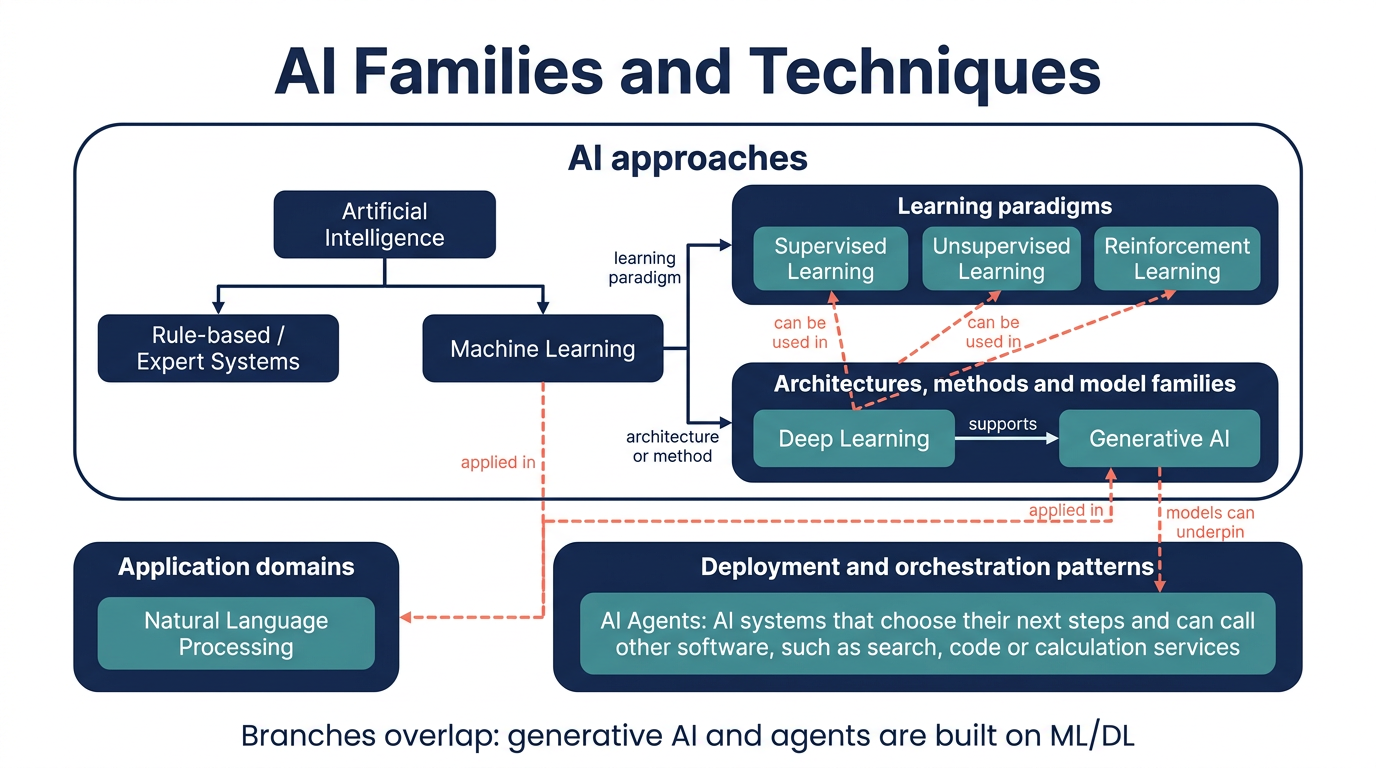
Families and how they learn
The cards distinguish explicitly encoded knowledge from behavior learned through data or feedback. See the expert system card for specialist knowledge and rules, and the machine learning card for behavior developed from data or experience [S4].
The learning cards are organized by the information available during training: unsupervised learning uses data without target labels; supervised learning uses input-target examples; semi-supervised learning combines labeled and unlabeled examples; reinforcement learning uses rewards from interaction [S4].
For multi-layer neural networks, parameters, and weights, see the deep learning card [S14]. For computational work with human language, see the natural language processing card [S4].
For transfer to classes without labeled training examples, and for the separate prompting sense of zero-shot, see the zero-shot learning card [S18] [S27].
For content generation, verification, and its risks, see the generative AI card [S11]. A large language model (LLM) is a language model trained at large scale to model language patterns. See the large language model card for this course's working definition and the specific contribution of the Transformer paper [S16].
For model-directed steps, tool use, and autonomy, see the AI agent card [S19].
Organizing the academy exercises
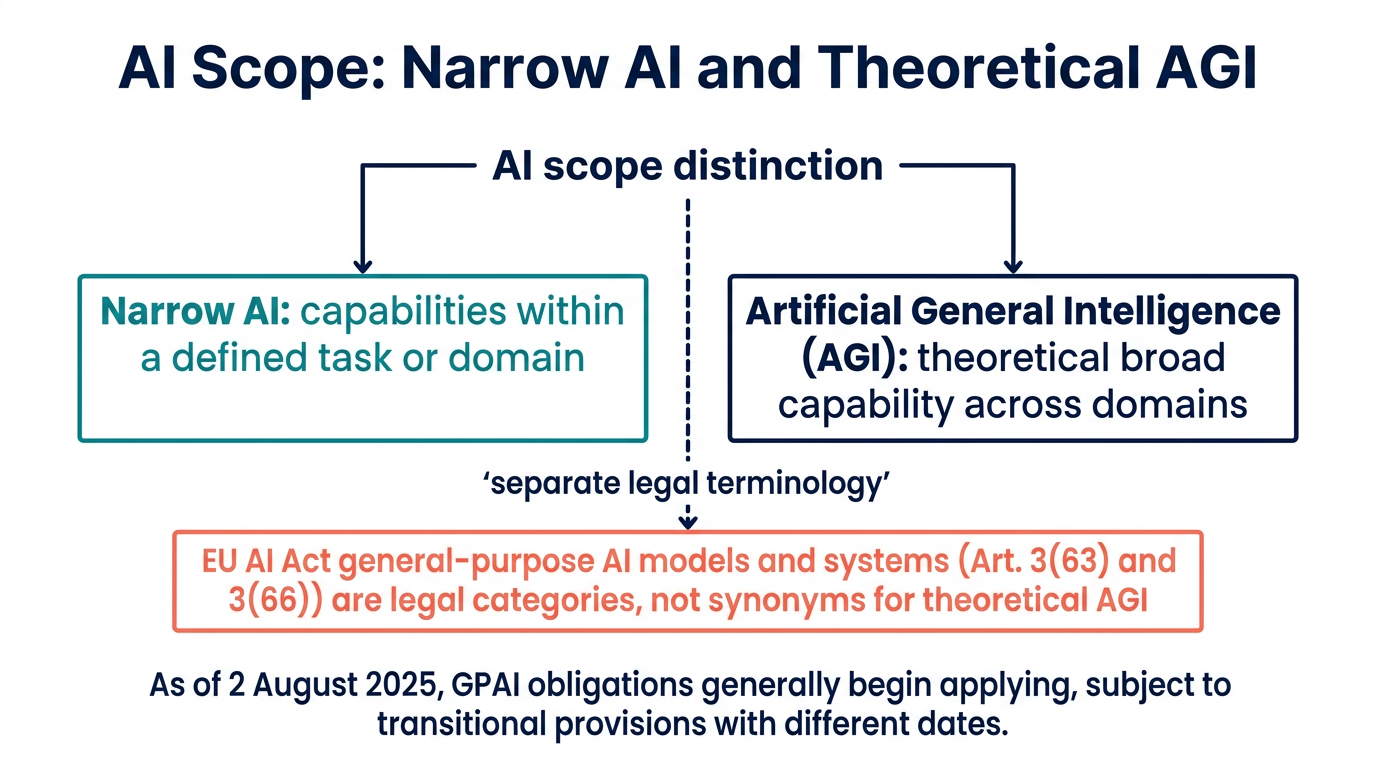
The concept cards establish AI, model families, and learning approaches without presenting them as a ladder of increasing capability. S4 supplies the terminology foundation for AI systems and machine learning. S5 supports examining governance-relevant characteristics such as complexity, opacity, autonomy, speed and scale, and dependence on data [S4] [S5]. These are separate questions: a model's family does not by itself determine its deployment risk.
Who gets hurt, and how
The academy uses four harm lenses: individuals, organizations, affected groups, and society. This is a noncanonical teaching grouping, not an official risk taxonomy. AI risk review should examine effects on people, organizations, and wider society, including the consequences of a system's use [S5]. Generative-AI review also needs to consider false outputs, intellectual property concerns, misinformation, and supply-chain risks [S11].
The following are illustrative academy examples, not source-defined categories or evidence of actual events:
- Individuals: A permit training extract retains exact addresses and unnecessary contact notes. Reviewers examine privacy exposure and whether each field is needed for the stated purpose [S9].
- Organizations: A permit supplier outage interrupts service, illustrating operational risk. Unclear processing duties raise legal and regulatory questions. Campaign-picture rework illustrates financial exposure, while invented library lending rules illustrate possible reputational damage. A support assistant that closes unresolved tickets to improve its closure-speed score illustrates a mismatch between the measured target and the intended outcome.
- Affected groups: A sorting arm changes warehouse tasks and proposed staffing, illustrating questions about job displacement. An employer limits an AI learning assistant to higher-paid roles, illustrating questions about economic inequality. These examples do not establish actual employment or income effects.
- Society: Generated posts attributed to fictitious residents illustrate manipulation of public opinion through a false appearance of independent support. Repeated omission of a residents' association from neighborhood summaries illustrates a possible concern for social cohesion. Reviewers must establish the pattern and investigate wider effects rather than assume them.
One incident can affect more than one lens. The grouping helps reviewers ask who bears a consequence; it does not turn each example label into an exam-ready technical definition.
The principles that answer the risks
Safety means managing or avoiding unacceptable harm or risk to people's health, safety, or rights, or to property or the environment, under stated conditions of use. It is not a promise that a system can never cause harm [S5, section 3.2]. Validity and reliability concern whether a system meets its intended requirements and performs as required under stated conditions, including robustness to errors and changing conditions [S5, section 3.1]. Testing, fallback arrangements, fail-safes, and monitoring are controls that support these characteristics, not guarantees of harmlessness [S5, sections 3.1 and 3.2].
Lifecycle review practice
AI policies and procedures should cover the lifecycle, including management of third-party and supply-chain risk [S12]. In the academy's illustrative permit exercise, governance assigns responsibilities and operating limits; operational controls define how officers use recommendations and maintain service when the model is unavailable. These are exercise design choices, not a prescribed checklist.
The exercise calls a failure to meet an agreed requirement a nonconformity. Officers document the affected version and evidence, assign responsibility for correction, investigate the cause, and retest before treating the action as effective. This is an academy corrective-action procedure within lifecycle policies and procedures [S12], not a claim that the source prescribes these exact steps or record fields. Review continues after release and when systems, uses, or suppliers change.
For cross-functional responsibilities, effective oversight, fallback design, personal-data handling, and fairness controls, see the cross-functional collaboration, human in the loop, fail-safe, deidentification, and bias mitigation cards [S5] [S8] [S9].
Optional appendix: illustrative only, not an exam taxonomy; real systems need not fit one category
Illustrative academy scenario: a municipal permit model receives application details, predicts which applications need specialist review, produces a review recommendation, and supplies it to a permit officer. Use the four course checklist questions to examine the system. The example does not establish a capability category or a ladder of AI types.
The concepts
artificial intelligence
Domain IAI names the field; an AI system is an application of its capabilities.
AI names the field; an AI system is an application of its capabilities. See the sourced definition below.
Think of it as Think of AI as a field of engineering and an AI system as one system built using its methods.
Where the simple version breaks: The output alone does not identify the method. Ordinary software can also produce recommendations or decisions.
Precisely: Plain-language paraphrase of S4: AI is the field concerned with computational capabilities such as learning and reasoning. An AI system uses those capabilities to produce results for objectives set by people [S4].
The problem: We need to distinguish the field of AI from individual AI systems so governance can target systems and their uses.
What must be true
- Plain-language paraphrase of S4: AI is the field concerned with computational capabilities such as learning and reasoning [S4].
- An AI system puts such capabilities to use for objectives set by people [S4].
- Its results can include predictions, recommendations, decisions, or content [S4].
- S4 supports the distinction between the field and an individual system; these explanations are not quotations.
- The course checklist examines inputs, objectives, outputs, and how outputs are used.
The assumption to question: AI means a single technology or a robot with a human-like mind.
Rebuilding it
- Separate the field of AI from an individual system.
- Identify the system's human-defined objective.
- Identify the outputs it produces.
- Examine its inputs and how people or other systems use its outputs.
- Do not treat the checklist alone as proof that software is AI.
Plain-language paraphrase of S4: AI is the field concerned with computational capabilities such as learning and reasoning. An AI system uses those capabilities to produce results for objectives set by people [S4].
Traps
- Any software that automates a task. Automation alone does not establish that a system is AI.
- A robot with consciousness. Neither a physical body nor consciousness is required by this definition.
- A specific algorithm like a neural network. AI is the field, not one technique.
Refer to the illustrative municipal permit scenario in the optional appendix. Use the four checklist questions to examine the model and the officer's use of its recommendation, rather than treating its output alone as proof that it is AI.
- What four questions make up the course checklist for examining an AI system?
- Why is AI a field rather than a single technology?
expert system
Domain IAn expert system uses represented specialist knowledge to work through a defined kind of problem [S4].
An expert system uses represented specialist knowledge to work through a defined kind of problem [S4].
Think of it as A recipe book paired with a process for choosing which instructions apply.
Where the simple version breaks: Rules may be incomplete or interact in unexpected ways. An explicit rule set is not automatically correct or easy to audit.
Precisely: Plain-language paraphrase of S4: an expert system combines represented domain knowledge with an inference process to produce conclusions about problems in that domain [S4].
The problem: Specialist knowledge can sometimes be represented explicitly and applied to new cases, rather than learned from examples [S4].
What must be true
- An expert system represents and applies knowledge from a particular domain [S4].
- A knowledge base holds the represented facts and relationships; an inference process uses them to derive conclusions [S4].
- Rules are one way to represent that knowledge [S4].
- Inspecting explicit rules can help reviewers, but it does not establish that the knowledge is complete or current.
The assumption to question: An expert system is simply a collection of facts.
Rebuilding it
- Identify the specialist problem and the knowledge needed to address it.
- Represent the relevant facts and rules.
- Specify how the system applies that knowledge to a case [S4].
- In the academy exercise, trace the resulting conclusion and check the currency of the rules.
Plain-language paraphrase of S4: an expert system combines represented domain knowledge with an inference process to produce conclusions about problems in that domain [S4].
Traps
- Any system that learns from data. Learning from examples alone does not establish the knowledge-based structure described here [S4].
- A database of facts. Stored knowledge alone does not supply the inference process that applies it [S4].
- Explicit rules guarantee correct conclusions. The academy exercise also checks whether the rules are current and applicable.
Illustrative academy scenario: a tax eligibility tool applies specialist-authored facts and if-then rules. Reviewers trace which rules produced an outcome and check whether the rules are current.
- How do the knowledge base and inference process differ?
- What can a rule trace show, and what does it not establish?
machine learning
Domain IThe model learns patterns from examples instead of receiving a hand-written response for every case [S4].
The model learns patterns from examples instead of receiving a hand-written response for every case [S4].
Think of it as Illustrative academy analogy: an agricultural forecasting tool is tuned against past soil-moisture records rather than having every forecast set by hand.
Where the simple version breaks: The analogy does not imply human understanding. People still choose the training method and objective, and more training does not guarantee better performance. Giving the tool recent observations during use does not necessarily retrain it.
Precisely: Plain-language paraphrase of S4: machine learning develops models by using data or experience to change their behavior, rather than having people specify every response in advance [S4].
The problem: Some tasks contain too many changing patterns to specify every response by hand. We need a way to develop model behavior from data or experience [S4].
What must be true
- Machine learning develops model behavior through data or experience rather than a hand-written response for every case [S4].
- Training data, evaluation data, and operational inputs have different roles. Data dependency requires governance attention [S4] [S5].
- Retaining earlier observations or supplying conversation history is not, by itself, learning. Applying a trained model need not update its learned behavior [S4].
- A bounded operational context does not establish what the organization retains elsewhere. Personal-data purpose and necessity must be assessed separately [S9].
- Training completion does not establish suitability for deployment; performance and limitations need evaluation in the proposed context [S5].
The assumption to question: Machine learning removes the need for people to choose objectives, data, and evaluation checks.
Rebuilding it
- State the forecasting objective and the information available when a forecast is made.
- Select training records and a method for developing the model's behavior.
- Keep separate records for testing in the illustrative academy exercise.
- Compare forecasts with observed outcomes and inspect important failure cases.
- Identify whether operational inputs include retained observations and whether any process actually updates the model.
- Decide whether the model is suitable for the proposed use, not just whether training completed.
Plain-language paraphrase of S4: machine learning develops models by using data or experience to change their behavior, rather than having people specify every response in advance [S4].
Traps
- Any program that stores data is learning.. Storage alone does not develop model behavior from data or experience [S4].
- A model must keep learning whenever it makes a prediction.. Applying learned behavior and updating it are distinct activities [S4].
- A short input history proves that older records are deleted.. Operational context and organizational retention are separate questions; personal-data processing still requires assessment [S9].
- Successful training proves suitability for deployment.. The exercise separately tests performance and examines data dependency and other governance concerns [S5].
Illustrative academy scenario: an agricultural advisory team trains a soil-moisture forecasting model on sensor and weather records. It tests forecasts on records excluded from training, including unusually dry periods. During use, the model receives recent observations without updating its learned parameters. Reviewers examine that input context separately from the team's storage arrangements. If forecasts are unsuitable, the team restricts the proposed use rather than treating training completion as approval.
- What distinguishes learning from storing records?
- Which information must be available at forecast time?
- Why should the team examine dry-period errors separately?
- Does applying the trained model necessarily update it?
- Why does an input-context limit not establish a retention policy?
unsupervised learning
Domain IThe model looks for structure without being given a target answer for each example [S4].
The model looks for structure without being given a target answer for each example [S4].
Think of it as Illustrative academy analogy: a retailer sorts baskets by similarities in their contents without supplying customer-segment names.
Where the simple version breaks: Similarity depends on the chosen representation and method. The resulting groups need not match useful human categories.
Precisely: Plain-language paraphrase of S4: unsupervised learning uses training data without target labels to develop representations or identify structure in the data [S4].
The problem: A project may have observations but no target answers attached to them. It can still investigate statistical structure in those observations [S4].
What must be true
- Unsupervised learning develops patterns or representations without target labels for the training examples [S4].
- Grouping similar observations is one possible task [S4].
- People still select the data, representation, method, and criteria for assessing usefulness.
- A statistical grouping is not automatically a meaningful or fair human category [S5].
The assumption to question: Without labels, learning has no human design choices.
Rebuilding it
- Identify which observations are available and confirm that target labels are absent.
- Choose a question about structure, such as which purchase patterns are similar.
- Apply a method suited to that question [S4].
- In the academy exercise, inspect whether the resulting groups are useful and whether their use could cause harm.
Plain-language paraphrase of S4: unsupervised learning uses training data without target labels to develop representations or identify structure in the data [S4].
Traps
- Learning from input-target pairs. That describes supervised learning rather than the absence of target labels [S4].
- Learning from rewards for actions. That feedback structure belongs to reinforcement learning [S4].
- The groups discovered must be socially meaningful. Statistical structure does not establish the appropriateness of using a grouping for decisions about people [S5].
Illustrative academy scenario: a retailer groups customers by purchase patterns without providing target segment labels.
- What is absent from the training examples in unsupervised learning?
- Which human choices influence the resulting groups?
supervised learning
Domain IThe model practices on examples that include the result it is being trained to predict [S4].
The model practices on examples that include the result it is being trained to predict [S4].
Think of it as Illustrative academy analogy: completed library loan records pair checkout details with the eventual return time.
Where the simple version breaks: Recorded answers can be wrong or incomplete. The model learns a relationship, not a reader's reasons for returning an item.
Precisely: Plain-language paraphrase of S4: supervised learning develops a model from training examples that associate inputs with specified target outputs [S4].
The problem: A model can learn a relationship when training records pair the information it will receive with a target result [S4].
What must be true
- Supervised learning uses training examples with target labels or values [S4].
- A target can be a category or a numerical quantity [S4].
- The target represents what the model is trained to predict, not an automatic guarantee of truth.
- Data quality and harmful bias require assessment before relying on the learned relationship [S5].
The assumption to question: Having a recorded target makes every training example correct and appropriate.
Rebuilding it
- In the illustrative library scenario, identify what is known at checkout.
- Pair that information with the recorded number of days until return.
- Use those pairs to develop a prediction model [S4].
- Check target-recording errors and evaluate predictions on separate records in the exercise.
Plain-language paraphrase of S4: supervised learning develops a model from training examples that associate inputs with specified target outputs [S4].
Traps
- The target must be a category. A numerical target, such as days until return, can also support supervised learning [S4].
- An employee must supervise every prediction. Supervised describes the training information, not a requirement for a person to approve every operational prediction [S4].
- More labels automatically resolve harmful bias. The quality, relevance, and effects of the data still need assessment [S5].
Illustrative academy scenario: a library trains a model to estimate return times using completed lending records. Each training example pairs checkout details with the recorded number of days until return, which is the target label. Reviewers check for missing or incorrect return dates.
- What role do target values play in supervised learning?
- Why does a recorded target still need quality checks?
semi-supervised learning
Domain ITraining uses some examples with target answers and others without them [S4].
Training uses some examples with target answers and others without them [S4].
Think of it as Illustrative academy analogy: a scheduling-complaint project has a small labeled message collection and a larger unlabeled collection.
Where the simple version breaks: The analogy does not explain how a particular method combines the collections. Unlabeled patterns can still be misleading.
Precisely: Plain-language paraphrase of S4: semi-supervised learning develops a model using both labeled and unlabeled data during training [S4].
The problem: A project may have many observations but target answers for only some of them. It can use both sets in training [S4].
What must be true
- Semi-supervised learning uses labeled and unlabeled training examples together [S4].
- It differs from training only on labeled examples or only on unlabeled examples [S4].
- Unlabeled examples do not become verified target answers merely because they are used during training.
- The quality and suitability of both parts of the dataset require review [S5].
The assumption to question: Using unlabeled data removes the need to evaluate the model against reliable target answers.
Rebuilding it
- Identify which examples have target labels and which do not.
- Choose a training method that can use both kinds of information [S4].
- In the academy exercise, retain a separate labeled test set.
- Investigate errors rather than assuming that a larger training pool guarantees better results.
Plain-language paraphrase of S4: semi-supervised learning develops a model using both labeled and unlabeled data during training [S4].
Traps
- Training on labeled data and testing on unlabeled data is sufficient. The defining combination concerns the information used during training [S4].
- Only unlabeled examples are used. Semi-supervised learning also uses labeled training examples [S4].
- The unlabeled portion cannot affect harmful bias. All training data need scrutiny for their effects on model behavior [S5].
Illustrative academy scenario: a school timetabling project trains a model to classify scheduling complaints using a few hundred messages labeled by conflict type and thousands of unlabeled messages. Reviewers evaluate it on a separate labeled test set.
- Which two kinds of training information are combined?
- Why does the academy exercise retain a separate labeled test set?
reinforcement learning
Domain IThe system learns which actions to choose from the rewards produced by its interactions [S4].
The system learns which actions to choose from the rewards produced by its interactions [S4].
Think of it as A game player tries moves across repeated games and uses the resulting scores to improve its choices.
Where the simple version breaks: A score is not a complete statement of every acceptable behavior. Reviewers must examine what the reward encourages.
Precisely: Plain-language paraphrase of S4: reinforcement learning develops a policy for selecting actions through interaction with an environment and reward feedback [S4].
The problem: Some learning problems concern choosing actions whose consequences unfold through interaction, rather than predicting a supplied target for each input [S4].
What must be true
- Reinforcement learning develops action-selection behavior using rewards from interaction with an environment [S4].
- The learning process concerns the consequences of actions, which may extend beyond a single step [S4].
- The reward signal is a design choice and must be assessed against the intended use.
- A reinforcement-learning agent is not necessarily an LLM-based AI agent; these terms describe different aspects of a system [S4] [S19].
The assumption to question: Improving reward automatically proves improvement in the real-world outcome people want.
Rebuilding it
- Identify the available actions and the environment in which they occur.
- Specify the reward feedback used for learning [S4].
- Let the learning process adjust action choices through interaction.
- In the academy exercise, test whether reward-seeking behavior also meets the stated requirements.
Plain-language paraphrase of S4: reinforcement learning develops a policy for selecting actions through interaction with an environment and reward feedback [S4].
Traps
- The feedback must provide the correct action for every situation. Reward feedback is not the same as supplying a target action for each example [S4].
- Any system described as an agent uses reinforcement learning. An LLM-based agent can direct tools and steps without that description establishing its training method [S19].
- No feedback is needed. Reward feedback is central to this learning approach [S4].
Illustrative academy scenario: a game-playing system learns action choices through repeated play and rewards based on game outcomes.
- How does reward feedback differ from a target label?
- Why should reviewers compare reward-seeking behavior with the intended requirements?
deep learning
Domain IDeep learning uses several layers of learned transformations to turn inputs into useful outputs [S14].
Deep learning uses several layers of learned transformations to turn inputs into useful outputs [S14].
Think of it as An assembly line where each stage transforms what it receives before passing it onward.
Where the simple version breaks: The stages are mathematical operations, not workers who understand the task. More layers do not guarantee a better result.
Precisely: Deep learning is a form of machine learning that uses multi-layer neural networks to learn representations and task behavior from data [S14].
The problem: A model may need to learn useful representations from complex inputs instead of relying entirely on manually selected features [S14].
What must be true
- Deep learning is machine learning using neural networks with multiple layers [S14].
- Successive layers transform their inputs into representations used by later layers [S14].
- Parameters are numerical settings adjusted during training; weights are parameters that control contributions within those transformations [S14].
- Network depth is distinct from whether training uses labels, unlabeled data, or rewards.
- Complex learned behavior can create opacity that requires governance attention [S5].
The assumption to question: Deep learning means the system thinks deeply.
Rebuilding it
- Identify the input and the output needed for the task.
- Use multiple layers of transformations to develop useful representations [S14].
- Adjust model parameters during training [S14].
- In the academy exercise, test outputs and investigate failure cases rather than inferring understanding from network depth.
Deep learning is a form of machine learning that uses multi-layer neural networks to learn representations and task behavior from data [S14].
Traps
- Machine learning that merely uses more records. Deep refers to the network's layers, not the number of training records [S14].
- AI that reasons deeply. Network depth is an architectural property, not evidence of human-like reasoning [S14].
- Deep learning and supervised learning are mutually exclusive. Architecture and the information used for training are separate dimensions; a multi-layer network can be trained on labeled examples [S14].
Illustrative academy scenario: a multi-layer neural network learns from labeled package images to identify damaged packaging.
- What does deep refer to in deep learning?
- How do network architecture and training feedback differ?
natural language processing
Domain INLP is computational work with human language, not just producing replies [S4].
NLP is computational work with human language, not just producing replies [S4].
Think of it as A language workbench with tools for sorting messages, translating sentences, and drafting replies.
Where the simple version breaks: A tool's success on one language task does not establish success on the others.
Precisely: Plain-language paraphrase of S4: natural language processing uses computational techniques to analyze, transform, or generate human language [S4].
The problem: Applications need computational methods for working with language in text or speech [S4].
What must be true
- Natural language processing concerns computational analysis and production of human language [S4].
- Tasks include extracting information, classifying messages, translating, and generating language [S4].
- NLP describes the kind of information and task, not a single learning method [S4].
- A system can perform a language task without performing every other language task.
The assumption to question: NLP is simply another name for a generative chatbot.
Rebuilding it
- Identify the language input and the intended task.
- Specify whether the output is a label, extracted information, translation, or generated text.
- Select and evaluate a method suited to that task [S4].
- In the academy exercise, evaluate message classification separately from reply drafting.
Plain-language paraphrase of S4: natural language processing uses computational techniques to analyze, transform, or generate human language [S4].
Traps
- Any system that stores text. Storage alone does not establish a language-processing task [S4].
- A system must both interpret and generate language. A single task, such as message classification, can be an NLP application [S4].
- NLP identifies one particular architecture. It describes work with language, not a single model architecture [S4].
Illustrative academy scenario: a support tool classifies incoming messages by topic and drafts replies. Both functions are language-processing tasks.
- What are three examples of NLP tasks?
- Why should classification and reply generation be evaluated separately?
zero-shot learning
Domain IIn classification, zero-shot learning uses a bridge learned from some classes to predict other classes with no labeled training examples [S18].
In classification, zero-shot learning uses a bridge learned from some classes to predict other classes with no labeled training examples [S18]. In the academy's prompting exercise, zero-shot means asking an LLM for an answer without putting example answers in the prompt.
Think of it as Illustrative academy analogy: a mineral-sorting model learns links between sample measurements and class attributes for known minerals. Attribute descriptions give it a way to consider another mineral class without labeled samples of that class. In a separate illustrative prompting exercise, a support team asks an LLM to label a message without showing it sample messages and their answers.
Where the simple version breaks: A description is not a substitute for testing. Classes may share attributes, and the learned links may not transfer well; zero-shot performance is usually below supervised performance [S18]. Likewise, omitting example answers from a prompt does not establish accuracy or reveal what appeared in prior training.
Precisely: In S18's classification setting, zero-shot learning transfers a learned relationship between input features and auxiliary semantic information from seen classes to unseen classes. The unseen classes have semantic descriptions but no labeled training examples [S18]. For the academy's LLM-prompting exercise, the working meaning of zero-shot prompting is answering a task without in-context example answers, meaning example answers supplied within the prompt.
The problem: A classifier may need to assign inputs to classes for which no labeled training examples are available. We need a way to transfer learning from other classes. Also distinguish this classification sense from the prompting convention used in the academy exercise below.
What must be true
- In the classification setting described by S18, labeled training examples are available for seen classes but not for the unseen target classes [S18].
- Auxiliary semantic information, such as class attributes or text descriptions, connects seen and unseen classes [S18].
- The model uses the learned connection between input features and semantic information to make predictions for unseen classes [S18].
- Zero-shot performance is usually below supervised performance [S18].
- For the academy's prompting exercise, a large language model (LLM) is a model trained at large scale to work with language patterns; see the large language model card below. The exercise uses zero-shot prompting to mean asking it to answer without supplying example answers in the prompt.
- In that prompting exercise, no example answers in the prompt does not mean no prior training.
The assumption to question: Zero-shot means the model knows nothing about the new category, or that every use of the term describes the same setup.
Rebuilding it
- First determine whether the task concerns unseen-class classification or the academy's LLM-prompting convention.
- For unseen-class classification, start with labeled examples from seen classes and semantic descriptions of both seen and unseen classes.
- Learn how input features relate to the semantic information.
- Use that relationship to predict classes that had no labeled training examples.
- Test unseen-class performance rather than assuming that semantic descriptions guarantee accuracy [S18].
- For the illustrative prompting exercise, provide the task and input without example answers, then check the generated answer rather than assuming it is correct [S15].
In S18's classification setting, zero-shot learning transfers a learned relationship between input features and auxiliary semantic information from seen classes to unseen classes. The unseen classes have semantic descriptions but no labeled training examples [S18]. For the academy's LLM-prompting exercise, the working meaning of zero-shot prompting is answering a task without in-context example answers, meaning example answers supplied within the prompt.
Traps
- Learning with no data or prior information. The classification model learns from seen-class data and uses auxiliary semantic information to connect that learning to unseen classes [S18]. In the prompting exercise, the absence of example answers in the prompt does not imply an untrained model.
- Any successful prediction on an unfamiliar input is zero-shot learning. A new input can belong to a class represented in training. In the classification sense, the distinction is the absence of labeled training examples for the target class and the use of semantic information for transfer [S18].
- Semantic descriptions make unseen-class predictions as reliable as supervised predictions. The transfer can fail, and zero-shot performance is usually below supervised performance [S18].
- Zero-shot always refers to the same absence of examples. Determine which sense the question uses. Unseen-class classification concerns missing labeled training examples for target classes [S18]. The academy's LLM-prompting convention concerns missing example answers within the prompt, not necessarily missing examples in prior training.
Illustrative academy scenario: a mineral-sorting project trains on labeled samples from several mineral classes and their attribute descriptions. It then uses the same attribute scheme to predict a class with no labeled training samples. Reviewers test whether the transferred relationship works for that class rather than assuming accuracy. Separate illustrative prompting scenario: a support team asks an LLM, 'Label this message as billing or technical: I was charged twice.' The prompt provides no example answers. Reviewers call this zero-shot prompting within the exercise and still check the answer.
- How does auxiliary semantic information connect seen and unseen classes?
- Why is an unfamiliar input not enough, by itself, to make a prediction zero-shot?
- What is absent in the classification sense, and what is absent in the academy's prompting sense?
- Why does a prompt without example answers tell you nothing certain about the model's prior training examples?
generative AI
Domain IGenerative AI produces content, but producing a convincing answer is not the same as verifying it [S11].
Generative AI produces content, but producing a convincing answer is not the same as verifying it [S11].
Think of it as Illustrative academy analogy: a draft may look ready to publish while still needing factual, rights, and suitability checks.
Where the simple version breaks: A polished explanation can conceal an invalid conclusion. Emotional or empathetic wording also does not establish human-like understanding.
Precisely: Generative AI is AI that generates content such as text, images, or other media. Its outputs can include false or misleading material and require evaluation appropriate to their use [S11].
The problem: Some tasks require creating new content, not just classifying. We need models that generate.
What must be true
- Generative AI generates content such as text, images, or media [S11].
- Generated content can be plausible without being correct; false outputs and misinformation are governance risks [S11].
- Potential for harm and misuse includes misleading content, intellectual property concerns, and disclosure of sensitive information [S11].
- A generated explanation must be checked rather than accepted as proof that a conclusion is valid [S11].
- In the academy exercises, emotional wording and descriptions of a person's beliefs are evaluated as outputs, not treated as evidence of human-like understanding.
The assumption to question: Generative AI understands the content it creates.
Rebuilding it
- Identify the content task and the intended use.
- Define what would make an output acceptable.
- Check factual claims against appropriate evidence [S11].
- In the illustrative timetable exercise, test the proposed schedule against every room and staffing constraint, independently of its explanation.
- In the illustrative tutoring exercise, check whether the reply correctly addresses the learner's stated mathematical mistake.
- Record observed task performance and limitations rather than infer mental states from fluent wording.
Generative AI is AI that generates content such as text, images, or other media. Its outputs can include false or misleading material and require evaluation appropriate to their use [S11].
Traps
- AI that only classifies existing content. Generative AI produces content rather than only assigning a class [S11].
- A fluent explanation proves the conclusion. Generated content can be false or misleading; the conclusion needs independent checks [S11].
- A system saying it feels worried establishes a mental state. The academy exercise observes generated wording and does not infer a mental state from that wording.
Illustrative academy scenario: a communications team uses a text-to-image model to draft campaign pictures. Reviewers check the drafts for possible intellectual property problems and misleading content. In a separate school exercise, reviewers reject a fluently explained timetable because it assigns two classes to the same room at the same time.
- What distinguishes generative AI from classification AI?
- Why does generative output need verification?
- How would you check a proposed timetable independently of its explanation?
- What can reviewers observe without inferring human-like understanding?
large language model
Domain IA large language model learns language patterns at large scale and can use those patterns to produce text.
A large language model learns language patterns at large scale and can use those patterns to produce text.
Think of it as A writing assistant that suggests plausible continuations but whose statements still need checking.
Where the simple version breaks: The analogy does not explain the model's training or architecture. Plausible wording is not evidence that a claim is true.
Precisely: Course working definition: a large language model is a language model trained at large scale to model language patterns and, in generative use, produce text.
The problem: Language applications can use models trained at large scale. We need a working term that does not confuse a model type with a single architecture.
What must be true
- Course working definition: a large language model is a language model trained at large scale to model language patterns.
- In generative use, it produces text.
- Fluent output does not guarantee factual accuracy [S15].
- The 2017 Transformer paper introduced an architecture demonstrated on machine translation [S16].
- That paper does not establish that all LLMs use the Transformer architecture.
The assumption to question: A large language model is a database of facts.
Rebuilding it
- Start with a model that learns patterns in language.
- Train it at large scale.
- Use it for language tasks, including generation.
- Evaluate its outputs rather than treating fluent text as verified knowledge.
Course working definition: a large language model is a language model trained at large scale to model language patterns and, in generative use, produce text.
Traps
- A search engine that retrieves documents. Generation and retrieval are different functions, though a system can combine them.
- A verified database of all training text. Learned parameters are not a verified document index, and generated answers require checking.
- A model that must use the Transformer architecture. The Transformer paper introduced an architecture; it does not define every possible LLM architecture [S16].
The 2017 paper Attention Is All You Need introduced the Transformer architecture and evaluated it on machine translation [S16]. This is a specific architectural contribution, not evidence about every current LLM.
- What does a generative language model produce?
- Why is it wrong to treat an LLM as a fact database?
AI agent
Domain IThe model chooses what to do next, not just what words to output.
The model chooses what to do next, not just what words to output.
Think of it as Illustrative academy analogy: an assistant chooses which records to consult but must ask an officer before sending a response.
Where the simple version breaks: The assistant analogy suggests human judgment. A model can choose an unsuitable tool, misread its result, or continue without enough evidence. Exercise permissions must be enforced outside the model's promises.
Precisely: In the LLM-based architecture discussed here, an AI agent is a system in which an LLM dynamically directs its own process and tool use, unlike a workflow whose steps are arranged in advance [S19].
The problem: A request may require steps that cannot all be selected in advance. An LLM-based system can let the model choose the next step after seeing a tool's result, rather than follow only a fixed route [S19].
What must be true
- See the scoped definition in feynman.precise. It describes an LLM-based architecture, not every use of the word agent [S19].
- A goal states what the system is trying to accomplish; available tools determine which external operations it can attempt.
- In the model-directed loop, a tool result becomes information for selecting another step or stopping [S19].
- A predefined workflow can also use tools, so tool access alone does not distinguish an agent [S19].
- Model-directed choices increase autonomy and the need for boundaries and monitoring [S19].
The assumption to question: Adding a tool to a chatbot automatically makes it an agent, or an agent must be free of human checkpoints.
Rebuilding it
- Start with a goal: prepare an answer to a permit applicant's question.
- List possible operations: search the policy store, request missing facts, and draft an answer.
- Compare a fixed search-then-draft workflow with a model that chooses its next operation from the information available.
- For the model-directed design, return each tool result to the model so it can choose another step or stop [S19].
- In the academy exercise, enforce read-only search, a step limit, and officer approval before sending any answer.
- Test whether the system stops or seeks help when its tools cannot support an answer.
In the LLM-based architecture discussed here, an AI agent is a system in which an LLM dynamically directs its own process and tool use, unlike a workflow whose steps are arranged in advance [S19].
Traps
- Any system that calls a search tool is an agent.. A fixed workflow can call that tool without the model directing the process [S19].
- A human approval step rules out an agent architecture.. Model-directed work can operate within human checkpoints [S19].
- An agent's plan guarantees that it can complete the task.. The academy scenario tests tool results, stopping behavior, and approval boundaries rather than accepting the plan as evidence.
Illustrative academy scenario: a permit assistant searches a policy store, notices that the applicant has not supplied a building category, and chooses to request that fact instead of drafting immediately. After receiving it, the assistant searches again and drafts a response. A separate permission control prevents sending until an officer approves. Reviewers compare this model-directed sequence with a fixed search-then-draft workflow.
- Which component selects the next operation in the agent design?
- How does a tool result affect the next step?
- Why is tool access alone insufficient to identify an agent?
- What should happen if no tool result supports an answer?
cross-functional collaboration
Domain IBring the needed expertise together, but keep clear who must decide and act.
Bring the needed expertise together, but keep clear who must decide and act.
Think of it as Illustrative academy analogy: an inspection team needs several specialists, yet each finding still needs someone responsible for resolving it.
Where the simple version breaks: Different expertise does not mean every participant has the same authority or legal role.
Precisely: Academy working definition: cross-functional collaboration is coordinated work across relevant functions with explicit responsibilities. This is an exercise practice for applying accountability and, where applicable, legal role obligations under the EU AI Act and the GDPR, not an exact definition attributed to the sources [S5] [S8] [S9].
The problem: The permit exercise needs technical, operational, legal, and data-handling questions answered without losing clear responsibility.
What must be true
- The exercise's collaboration arrangement is an academy implementation choice, not a standardized AI type.
- Accountability is a responsible-AI concern [S5].
- Provider and deployer roles must be distinguished under the EU AI Act [S8].
- Under the GDPR, personal-data purposes, necessity, and controller obligations require attention in both training and inference [S9].
- A shared discussion does not, in this exercise, replace a named owner for each action.
The assumption to question: Inviting several teams to a meeting is enough to establish effective collaboration.
Rebuilding it
- State the decision or operational problem.
- Identify who can supply technical evidence, explain officer work, and assess legal and data obligations.
- Map provider and deployer roles under the EU AI Act and controller obligations under the GDPR, where applicable, rather than inferring them from job titles [S8] [S9].
- In the exercise, assign each unresolved question an owner and a way to verify the answer.
- Record disagreements and the accountable decision, then follow corrective work through retesting.
Academy working definition: cross-functional collaboration is coordinated work across relevant functions with explicit responsibilities. This is an exercise practice for applying accountability and, where applicable, legal role obligations under the EU AI Act and the GDPR, not an exact definition attributed to the sources [S5] [S8] [S9].
Traps
- Everyone attended, so responsibility is settled.. The exercise requires an identified decision owner and owners for unresolved actions.
- The software team's title determines every legal role.. Under the EU AI Act and the GDPR, where applicable, actual activities and the relevant legal definitions determine those roles [S8] [S9].
Illustrative academy scenario: permit officers report that a supplier update changes recommendations. Engineers compare versions, operations staff test the manual route, and legal and data staff examine role questions under the EU AI Act and processing questions under the GDPR, where applicable. The municipality names an action owner for each finding and verifies corrections rather than treating attendance as completion.
- Which expertise does this problem require?
- Who owns the decision and each corrective action?
- What evidence would distinguish coordination from a meeting with no follow-through?
human in the loop
Domain IThe person must be able to make a meaningful difference, not just confirm a screen.
The person must be able to make a meaningful difference, not just confirm a screen.
Think of it as Illustrative academy analogy: a reviewer needs both a clear view of the work and a usable way to stop it.
Where the simple version breaks: Human involvement can still be ineffective if information, time, competence, or authority is missing.
Precisely: In this lesson, human in the loop is shorthand for a design in which a person can meaningfully review and intervene. The sourced legal anchor is effective human oversight under the applicable EU AI Act requirements, not a claim that any human checkpoint is sufficient [S8].
The problem: A nominal human approval step may not give an officer a practical ability to understand, challenge, or stop an AI-supported action.
What must be true
- Effective human oversight is the source-backed requirement discussed here; the EU AI Act provides requirements for oversight of high-risk AI systems [S8].
- Whether those requirements apply to a particular deployment requires the relevant legal assessment [S8].
- The academy exercise gives officers usable information, authority to reject a recommendation, and a route to obtain help.
- The exercise tests actual intervention rather than counting approval clicks.
The assumption to question: A person clicking approve automatically establishes effective oversight.
Rebuilding it
- Identify the decision and when intervention can still matter.
- Determine the applicable oversight duties [S8].
- In the exercise, provide officers with the recommendation, relevant evidence, and known limitations.
- Give them authority and a practical route to reject, pause, or escalate.
- Test a deliberately unsuitable recommendation and observe whether the officer can intervene.
In this lesson, human in the loop is shorthand for a design in which a person can meaningfully review and intervene. The sourced legal anchor is effective human oversight under the applicable EU AI Act requirements, not a claim that any human checkpoint is sufficient [S8].
Traps
- An approval button alone proves effective oversight.. Effective oversight requires more than nominal human presence [S8]; the exercise tests meaningful intervention.
- A human can correct any error after the action is complete.. The scenario requires intervention while it can still prevent the unsuitable action.
Illustrative academy scenario: a permit officer receives a recommendation based on the wrong building category. During a supervised exercise, the officer can inspect that category, reject the recommendation, and request specialist review before a response is sent. Reviewers also test whether workload makes this intervention practical.
- What information lets the officer detect the error?
- What authority and control let the officer intervene?
- When would the intervention be too late?
fail-safe
Domain IPlan what the service should do when the AI cannot be relied on, then test that plan.
Plan what the service should do when the AI cannot be relied on, then test that plan.
Think of it as Illustrative academy analogy: a sorting line diverts uncertain parcels for inspection rather than guessing where to send them.
Where the simple version breaks: Stopping or diverting can create other problems. An acceptable fallback depends on the use and consequences.
Precisely: Academy working definition: a fail-safe is a designed response intended to keep a system within acceptable operating limits when a specified failure occurs. This exercise control applies safety and reliability principles; S5 is not cited as prescribing this exact mechanism [S5].
The problem: A service needs a planned response when AI output is unavailable or unsuitable, rather than continuing by default.
What must be true
- Safety and reliability are responsible-AI concerns [S5].
- The academy's fallback design is a chosen operational control, not a universal architecture prescribed by S5.
- The permit exercise defines a failure condition, a controlled fallback, and conditions for resuming model use.
- The fallback itself must be tested in the exercise; a written promise is not evidence of successful operation.
The assumption to question: Any system that stops producing AI output has necessarily reached an acceptable state.
Rebuilding it
- Identify failure conditions and the possible consequences.
- Choose a controlled response appropriate to the exercise's service needs.
- Assign authority to enter the fallback and to resume model use.
- Test the fallback with an unavailable supplier and missing records.
- Correct failures and repeat the test before relying on the arrangement.
Academy working definition: a fail-safe is a designed response intended to keep a system within acceptable operating limits when a specified failure occurs. This exercise control applies safety and reliability principles; S5 is not cited as prescribing this exact mechanism [S5].
Traps
- A fallback document establishes that the service can recover.. The academy exercise requires a practical test and evidence.
- Stopping the model resolves every service consequence.. The scenario also requires officers to continue necessary work through an acceptable route.
Illustrative academy scenario: when the permit prediction service times out, the application marks the recommendation unavailable and routes the case to a manual queue. Officers test access to the needed records. Model use resumes only after the exercise's designated owner verifies service restoration and the affected cases.
- What triggers the fallback?
- What makes the fallback acceptable for this service?
- Who can authorize resumption, and on what evidence?
deidentification
Domain IRemoving a direct identifier is one step; also ask what remains, why it is needed, and who can connect it to a person.
Removing a direct identifier is one step; also ask what remains, why it is needed, and who can connect it to a person.
Think of it as Illustrative academy analogy: covering a name on a permit form does not hide an identifying address elsewhere on the page.
Where the simple version breaks: The analogy does not determine legal anonymity or the adequacy of a particular technical method.
Precisely: Academy working definition: deidentification labels measures intended to reduce identifiability in the exercise's data. It is not a legal conclusion that the result is anonymous. Under the GDPR, the sourced requirements are purpose limitation, data minimisation, and applicable controller obligations [S9].
The problem: The permit exercise needs to reduce unnecessary exposure of personal data without assuming that removing names settles every data obligation.
What must be true
- The academy uses deidentification as an operational practice label, not a claim of a legally established anonymous status.
- Under the GDPR, purpose limitation, data minimisation, and controller obligations apply to personal data in training and inference [S9].
- The exercise separately examines which data are needed and whether remaining fields still relate to identifiable people.
- No technique in this scenario is presented as automatically removing GDPR obligations.
The assumption to question: Deleting a name automatically makes every remaining record anonymous and freely reusable.
Rebuilding it
- For processing subject to the GDPR, state the training or inference purpose [S9].
- Under the GDPR, identify which personal data are necessary for that purpose [S9].
- In the exercise, remove unnecessary fields and restrict access to any separately held identifying information.
- Review combinations of retained fields and the actual processing context.
- Obtain the appropriate data-protection assessment rather than declaring the records anonymous from a single transformation.
Academy working definition: deidentification labels measures intended to reduce identifiability in the exercise's data. It is not a legal conclusion that the result is anonymous. Under the GDPR, the sourced requirements are purpose limitation, data minimisation, and applicable controller obligations [S9].
Traps
- Removing names automatically ends personal-data obligations.. The exercise still examines the remaining data and context; applicable personal-data obligations under the GDPR must be assessed [S9].
- A deidentification step establishes that every retained field is necessary.. Under the GDPR, data minimisation is a separate necessity question [S9].
Illustrative academy scenario: a permit team removes applicant names from a proposed training extract but retains exact addresses and contact notes. Reviewers remove notes that are unnecessary for the stated purpose and assess the remaining fields and access arrangements. They do not describe the extract as anonymous merely because names were deleted.
- Which fields are necessary for the stated purpose?
- What could still connect the records to people?
- Which conclusion requires more than checking that names were removed?
bias mitigation
Domain IFind the harmful pattern, change what may cause it, and check whether the change actually helps.
Find the harmful pattern, change what may cause it, and check whether the change actually helps.
Think of it as Illustrative academy analogy: a sorting process is not fixed by improving its average if one parcel category is still repeatedly misrouted.
Where the simple version breaks: Human fairness involves context, rights, and competing considerations that a parcel analogy cannot capture.
Precisely: Academy working definition: bias mitigation is action intended to reduce identified harmful bias, followed by evaluation of its effects and limits. The source-backed principle is fairness with harmful bias managed, not a guarantee of bias-free results [S5].
The problem: A permit model's overall score may hide outcomes that need investigation for particular affected groups.
What must be true
- Fairness and management of harmful bias are responsible-AI concerns [S5].
- The academy's chosen comparison measures are exercise controls, not a universal fairness test prescribed by S5.
- Under the GDPR, if evaluating outcomes requires personal data, necessity, purpose, and controller obligations still require assessment [S9].
- The exercise treats an intervention as a proposal to test, not proof that all harmful bias has been removed.
The assumption to question: One aggregate accuracy score or one data change proves that a system is fair.
Rebuilding it
- Describe the decision, affected groups, and suspected harm.
- Choose relevant outcome comparisons and document why they matter in the exercise.
- For processing subject to the GDPR, assess the purpose and necessity of personal data used for evaluation [S9].
- Investigate differences and propose changes to data, model behavior, or the operating process.
- Retest relevant outcomes and record remaining limitations, using fairness as the governance anchor [S5].
Academy working definition: bias mitigation is action intended to reduce identified harmful bias, followed by evaluation of its effects and limits. The source-backed principle is fairness with harmful bias managed, not a guarantee of bias-free results [S5].
Traps
- Higher average accuracy proves every relevant group's outcomes improved.. The scenario requires checking the outcomes relevant to the suspected harmful pattern.
- Fairness evaluation creates an unrestricted right to collect personal data.. Under the GDPR, purpose limitation, data minimisation, and controller obligations still apply [S9].
- Applying a mitigation proves the concern is resolved.. The academy exercise requires retesting and documentation of remaining limitations.
Illustrative academy scenario: permit officers suspect that applications using a particular form format are disproportionately sent for unnecessary specialist review. Reviewers compare relevant outcomes, investigate data extraction errors, correct the parser, and retest. If further personal data are proposed for fairness analysis, the team first assesses their purpose and necessity rather than collecting them by default.
- What harmful pattern is being investigated?
- Which comparison would test whether the parser correction helped?
- What personal-data questions arise during evaluation?
- What limitations remain after a successful test?