Why AI needs its own kind of governance
AI and traditional software can share governance challenges. In AI systems, learned behavior, opacity, and deployment at speed and scale can make existing controls insufficient without adaptation. Governance needs to address the system's actual capabilities and use [S5].
Complexity
AI systems can be highly complex. Neural networks and deep learning use many layers and millions of parameters. Deep learning is machine learning with multiple processing layers [S14]. Parameters are adjustable values learned during training. Weights are parameters that control how strongly signals influence later calculations. The relationship between an input and an output is not a simple rule. It is a pattern spread across many weights. This makes input-output relationships hard to trace [S5].
Opacity
Opacity is a barrier to understanding a system's behavior. It can arise from complicated learned calculations, restricted access to information, or a mismatch between technical detail and the audience's knowledge. Access to code alone does not necessarily remove that barrier [S5][S26]. Illustrative academy scenario: a municipal permit model flags an application for extra review, but staff cannot reliably identify what drove the flag. The cards below revisit this scenario from different governance perspectives.
Explainability, interpretability, transparency
These concepts overlap, and frameworks draw their boundaries differently. This section follows NIST's framing: explainability concerns the mechanisms or factors producing behavior; interpretability concerns the meaning of behavior or an output in context. Other frameworks sometimes use interpretability more broadly [S5][S26].
An explanation should help its audience examine what produced a system's behavior. It might address a pattern across many results or the factors behind one result. Reviewers should check that the account reflects the system, rather than accepting a convincing story as evidence [S5][S26].
Interpretability asks what that behavior or result means in the setting where it is used. Understanding a score requires knowing what it represents and how it should inform action. A chart of important inputs can contribute to understanding, but is not automatically a causal account [S5][S26].
Transparency makes oversight possible by giving relevant people usable information about the system and its use. The information needed may concern purpose, limitations, data practices, or responsibility. Disclosure can support explanation and interpretation without achieving either on its own [S5][S6].
Autonomy
Autonomy describes how much freedom a system has to select or carry out actions within the authority people give it. A person can start a task without approving every later step. Learning or changing over time is a separate capability, not a requirement for autonomy [S4][S5]. Illustrative academy scenario: a parcel-routing model redirects a parcel within approved delivery constraints without asking a dispatcher to approve that change. An agent can also select tools and steps while pursuing an assigned task [S19]. The EU AI Act requires effective human oversight for high-risk AI systems [S8].
Speed and scale
Speed concerns the rate at which a system handles work; scale concerns the reach or volume of that work. In a large deployment, an error can affect many people before reviewers detect it. Governance should therefore match monitoring, approval gates, and stopping controls to the deployment's pace and reach [S5]. Illustrative extension of the municipal permit scenario: the model flags an entire batch before staff examine the first result.
Data dependency
Data dependency means that a learned system's behavior is shaped by the data used to build, test, and operate it. Relevant coverage, accuracy, and fitness for the intended setting matter, not simply the amount collected. Missing groups, outdated examples, or unsuitable operational inputs can weaken results, so data needs continuing review [S5].
Probabilistic and deterministic outputs
Probabilistic output expresses estimated likelihoods or ranks possible results using those estimates. A high estimate is not a guarantee that an individual result is correct [S15]. Illustrative academy scenario: an agricultural advisory model ranks several causes of leaf damage and assigns its leading suggestion an estimated likelihood of 85 percent. Inspection may still show that another cause is responsible.
Deterministic output follows a fixed mapping: unchanged inputs and relevant operating conditions produce an unchanged result. Probabilistic and deterministic describe different aspects of a system. A deterministic computation can return the same probability estimate on every run. Repeatability therefore does not make a prediction certain. The distinction matters when deciding what to test and verify, and LLM-generated answers still need verification [S15].
Potential for harm and misuse
AI can be used intentionally or unintentionally to cause harm. For example, a generative model can produce misleading content. A model can be prompted to bypass safeguards. Governance must detect and prevent harmful uses and unintended consequences [S11].
Black box
When opacity is severe, people call the system a black box. The label means that the people assessing it lack a practical account of how its inputs lead to results. This can reflect complexity or missing information, rather than a special category of AI [S26].
Traditional software controls do not fully address these characteristics. AI needs tailored governance.
Summary
- Explainability concerns the mechanisms or factors producing a system's behaviour; interpretability concerns what that behaviour or an output means in its use context; transparency concerns making usable information about the system and its use available. Frameworks draw these boundaries differently [S5][S26].
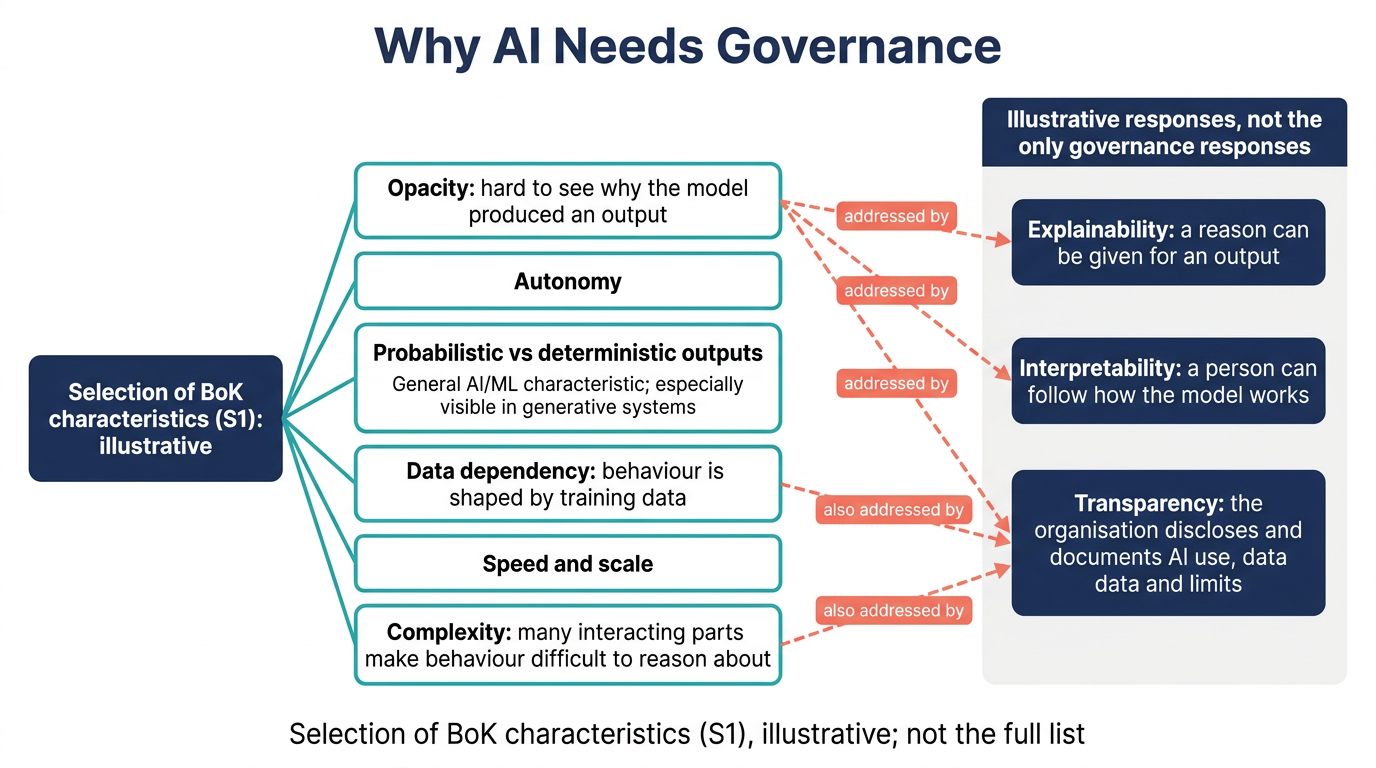 S1: opacity, meaning it is hard to see why the model produced an output; autonomy" loading="lazy">
The concepts
complexity
Domain IComplexity means the machine makes a decision using so many small knobs that no one can point to the one knob that decided it.
Complexity means the machine makes a decision using so many small knobs that no one can point to the one knob that decided it.
Think of it as It is like a recipe with a million ingredients. The cake tastes wrong, but you cannot tell which ingredient caused it.
Where the simple version breaks: The analogy suggests one ingredient is at fault. In a neural network, the fault may lie in the pattern of many ingredients together.
Precisely: Complexity is the property of AI systems, especially neural networks, that makes input-output relationships hard to trace [S5].
The problem: A system with millions of interacting parameters cannot be checked by reading code line by line. Parameters are adjustable values learned during training [S5].
What must be true
- Neural networks and deep learning use many layers. Deep learning is machine learning with multiple processing layers [S14].
- Each layer transforms data through learned weights. Weights are parameters that control the influence of signals on later calculations.
- The input-output relationship is distributed across many parameters.
- A single parameter usually cannot account for the final output [S5].
The assumption to question: Every system decision can be traced to a simple if-then rule.
Rebuilding it
- Start with a simple rule-based system where each decision maps to a visible rule.
- Add many learned parameters so the mapping is no longer visible.
- Notice that tracing one output to one cause becomes difficult.
- Conclude that complexity is a governance concern because direct inspection may be insufficient [S5].
The property of AI systems, especially neural networks, that makes input-output relationships hard to trace [S5].
Traps
- The number of lines of code in an AI system.. Complexity is about traceability of learned relationships, not code volume.
- The difficulty of installing AI software.. Installation difficulty is an operational issue, not the learned model's internal structure.
- A system that uses many rules.. Many explicit rules can still be traceable; complexity here refers to learned, distributed parameters.
Illustrative extension of the municipal permit scenario: the model uses a multilayer network to analyze application documents. Staff cannot trace a review flag to one parameter because many learned values interact.
- Why does a neural network with many layers make input-output relationships hard to trace?
- How is this different from a rule-based expert system with many rules? An expert system uses a knowledge base of domain facts and explicit inference rules to derive conclusions [S4].
opacity
Domain IOpacity means people cannot readily work out how a system arrived at its answer.
Opacity means people cannot readily work out how a system arrived at its answer.
Think of it as It is like receiving a grade without enough information to understand how it was awarded.
Where the simple version breaks: The missing information might be withheld, too complicated, or unsuitable for the audience. Those problems need different responses.
Precisely: Opacity is a barrier to understanding AI behavior that can arise from complexity, limited information, or limits in the audience's ability to use that information [S5][S26].
The problem: People may have difficulty checking or challenging a result when they cannot understand the process behind it.
What must be true
- A learned model need not represent its behavior as readable rules.
- Complexity can make a model difficult to understand even when its code is available.
- Restricted access to information can also create opacity.
- Whether an account is understandable depends partly on its audience [S5][S26].
The assumption to question: A system that works correctly must also be understandable.
Rebuilding it
- Start with a decision supported by a readable rule.
- Replace that rule with a learned model.
- Ask what information a reviewer needs to understand a result.
- Check whether the available evidence supplies that understanding.
- Treat the remaining barrier as opacity and address it through documentation, evaluation, and suitable explanations [S5][S26].
A barrier to understanding AI behavior, caused by factors such as complex calculations or unavailable information [S5][S26].
Traps
- The absence of a user interface.. Opacity concerns understanding behavior, not whether a screen is available.
- A system that is slow to respond.. Response time does not establish whether a result can be understood.
- Only a system with secret code can be opaque.. Open code can still leave learned behavior difficult to understand [S26].
Illustrative extension of the municipal permit scenario: staff receive access to the model's code, but still cannot give applicants a reliable account of what drove a review flag. Code access has not resolved the understanding barrier.
- Why might publishing code fail to remove opacity?
- How could complexity and restricted information create different barriers to understanding?
explainability
Domain IExplainability helps people examine what produced an AI system's behavior.
Explainability helps people examine what produced an AI system's behavior.
Think of it as It is like tracing how a set of gears moves a clock's hands, rather than merely reading the time.
Where the simple version breaks: A learned model may not offer a simple mechanical chain to inspect. An explanation may simplify its behavior, so reviewers must check what that simplification leaves out.
Precisely: In the NIST framing used here, explainability concerns the mechanisms or factors producing AI behavior. Accounts should be faithful and suitable for their audience; the concept overlaps with interpretability, with boundaries varying by framework [S5][S26].
The problem: Reviewers need evidence about what produces system behavior, not just an answer or a persuasive story.
What must be true
- Following NIST's framing, explainability concerns the mechanisms or factors producing AI behavior [S5].
- The question may concern one result or a broader pattern of behavior.
- An explanation needs to reflect the system and be usable by its intended audience [S5][S26].
- Explainability and interpretability overlap, and frameworks draw their boundary differently [S5][S26].
The assumption to question: A plausible account of a result is enough to explain it.
Rebuilding it
- Decide which aspect of the system's behavior needs investigation.
- Gather evidence about the mechanisms or factors that produced it.
- Test whether the proposed account fits that evidence.
- Present the account at a level the audience can use, with its limits made clear.
- Keep the explanation separate from judgments about whether the result is correct or acceptable [S5][S26].
An account of the mechanisms or factors producing AI behavior, following the NIST framing used here. Explainability overlaps with interpretability, and frameworks draw the boundary differently [S5][S26].
Traps
- Any fluent reason generated by the model.. Fluency does not show that a reason reflects the system's behavior.
- The accuracy of the model's predictions.. Performance and the ability to account for behavior are different properties.
- Explainability always concerns one output, while transparency always concerns internal records.. Explanations can address whole-system behavior, and transparency can include disclosures to outside stakeholders. Terminology varies across frameworks [S5][S26].
Illustrative extension of the municipal permit scenario: a review tool identifies inconsistent measurements as a contributor to a flag. Staff test whether changing those measurements affects the model as the explanation suggests, rather than accepting the reason at face value.
- What information does an explanation add to a decision?
- Why should a simplified explanation be checked for faithfulness?
interpretability
Domain IInterpretability means making sense of what a model's behavior or result means in the setting where it is used.
Interpretability means making sense of what a model's behavior or result means in the setting where it is used.
Think of it as It is like reading a score together with the scoring rules, rather than seeing only the final number.
Where the simple version breaks: A summary of important inputs may help, but it does not necessarily show causes or reveal every calculation.
Precisely: In the NIST framing used here, interpretability concerns the meaning of AI behavior or an output in context. It overlaps with explainability, and other frameworks may give it a broader scope [S5][S26].
The problem: People need to make sense of model behavior and outputs in the setting where they are used.
What must be true
- Following NIST's framing, interpretability concerns the meaning of behavior or an output in context [S5].
- A readable model structure can help people understand that meaning.
- Understanding an output also requires its use context.
- Interpretability has different boundaries across frameworks and often overlaps with explainability [S5][S26].
The assumption to question: Good test performance means people understand what the model has learned.
Rebuilding it
- Start with a trained model and a clearly stated use.
- Ask what its behavior or output means in that setting.
- Inspect a readable structure or use suitable analysis methods.
- Check the limits of those methods rather than treating a chart as a complete explanation.
- Describe what people can reasonably understand and what remains uncertain [S5][S26].
Making sense of the meaning of AI behavior or an output in context, following the NIST framing used here. Interpretability overlaps with explainability, and frameworks draw the boundary differently [S5][S26].
Traps
- Interpretability and explainability have one universally agreed boundary.. Frameworks use the terms differently and sometimes overlap them [S5][S26].
- A feature-importance ranking proves why an outcome occurred.. A ranking is a limited analytical view, not automatic proof of a causal account.
- High accuracy establishes interpretability.. Performance does not establish that people understand the behavior.
Illustrative academy scenario: a school timetabling model assigns a schedule a score of 0.8. Staff need to know whether that score represents room suitability, student preferences, or another objective before deciding how to use it.
- How can understanding input-output relationships help investigate bias?
- Why should governance documents state how they use interpretability and explainability?
transparency
Domain ITransparency means making the right information about an AI system available to the people who need it.
Transparency means making the right information about an AI system available to the people who need it.
Think of it as It is like a restaurant providing clear ingredient and allergy information to customers and staff.
Where the simple version breaks: An ingredient list does not describe every cooking step. Likewise, system disclosures need not explain every model calculation.
Precisely: Transparency concerns the availability of relevant, usable information about an AI system and its use. It is broader than internal organizational knowledge and does not guarantee interpretability [S5][S26].
The problem: People cannot exercise informed oversight if relevant information about an AI system is unavailable.
What must be true
- Different stakeholders need different information.
- Relevant information can include purpose, data practices, capabilities, limitations, and responsibility.
- Records and disclosures should be usable by their intended audience.
- Transparency can support understanding without guaranteeing an explanation of each result [S5].
The assumption to question: The technical team's knowledge automatically gives everyone else enough information.
Rebuilding it
- Identify the people responsible for oversight and those affected by use.
- Determine what information they need.
- Record and communicate the relevant purpose, practices, limits, and responsibilities.
- Keep that information current.
- Check whether it enables informed review rather than merely adding documents [S5].
Making relevant information about an AI system and its use available in a form appropriate for the intended stakeholders [S5].
Traps
- Publishing source code is always sufficient.. Stakeholders may also need information about use, data practices, limitations, and responsibility.
- Transparency guarantees that every prediction can be explained.. Disclosure and understanding model behavior are related but distinct goals [S5][S26].
- Transparency only concerns what the organization knows internally.. Relevant information may also need to reach users and other affected stakeholders [S5].
Illustrative extension of the municipal permit scenario: applicants receive a notice explaining the model's role and limits, while reviewers receive documentation about data practices and the team responsible for the system.
- Which stakeholders need information about an AI system, and what might each need?
- Why can a well-documented system still be difficult to interpret?
autonomy
Domain IAutonomy means a system has room to act without asking a person at every step.
Autonomy means a system has room to act without asking a person at every step.
Think of it as It is like giving an assistant a task and a spending limit instead of approving each purchase.
Where the simple version breaks: A system does not have a human assistant's judgment or responsibility. Its permission boundaries and oversight need to be explicit.
Precisely: Autonomy is the degree of freedom an AI system has to select or execute actions within assigned limits without direct human approval at each step [S4][S5].
The problem: A system may carry out consequential steps without a person approving each one.
What must be true
- People define a system's authority and operating limits.
- Within those limits, it may select or execute actions without case-by-case approval.
- A person can initiate the task while later steps remain autonomous.
- Autonomy does not require the system to learn or change over time [S4][S5].
The assumption to question: Human involvement at setup means a person controls every later action.
Rebuilding it
- Start with a system that requires approval for each action.
- Permit it to act within a defined boundary.
- Identify which choices now occur without direct approval.
- Assign responsibility for supervising those choices.
- Set approval gates, limits, and intervention options that fit the consequences [S5].
The degree to which an AI system selects or carries out actions within assigned limits without direct human approval of each step [S4][S5].
Traps
- A human-started task cannot be autonomous.. Later choices and actions may proceed without further approval.
- An autonomous system must update its own model.. Acting independently within limits and learning over time are separate capabilities.
- Fast processing establishes autonomy.. Processing rate says nothing about who authorizes each action.
Illustrative extension of the parcel-routing scenario: an agent selects a routing tool, checks available capacity, and redirects the parcel within its approved limits without seeking approval for each step.
- Why does autonomy require clear assignment of responsibility?
- What human-oversight requirement does the EU AI Act set for high-risk AI systems [S8]?
speed and scale
Domain ISpeed is how quickly work happens.
Speed is how quickly work happens. Scale is how much work, or how many people, it reaches.
Think of it as It is like a printing press spreading a mistake before an editor has checked the first batch.
Where the simple version breaks: A model need not repeat one identical mistake. Errors can differ across cases and remain hard to spot.
Precisely: Speed and scale describe a deployment's processing rate and operational reach, which can amplify exposure to errors before intervention [S5].
The problem: An error can spread widely before a review process detects it.
What must be true
- Speed concerns the rate of processing or action.
- Scale concerns the volume or reach of a deployment.
- Together they can increase how quickly a problem affects people.
- Controls need to fit the deployment's pace and reach rather than rely only on individual manual checks [S5].
The assumption to question: A review process designed for a few cases will remain effective at much greater throughput.
Rebuilding it
- Start with a small workload that reviewers can examine individually.
- Increase throughput and the number of affected people.
- Estimate how many cases could be affected before an alert is investigated.
- Set monitoring, approval thresholds, and stopping controls around that exposure.
- Keep human oversight focused where it can meaningfully influence outcomes [S5].
The rate and reach of AI operations, considered together because they affect how widely and quickly errors can spread [S5].
Traps
- The number of learned parameters.. Parameter count concerns model structure, not deployment throughput or reach.
- Permission to act without individual approval.. That concerns autonomy, which is separate from rate and reach.
- The correctness of each result.. A system can be fast and widely deployed while still making errors.
Illustrative extension of the municipal permit scenario: a faulty update causes unnecessary review flags across a large batch. A batch-size limit and an early checkpoint could reduce the number affected before staff intervene.
- When might manual case-by-case review become insufficient?
- Which controls could limit harm before a high-throughput deployment is stopped?
data dependency
Domain IData dependency means a model's results rely on the examples and inputs it has been given.
Data dependency means a model's results rely on the examples and inputs it has been given.
Think of it as It is like training a receptionist only on weekday enquiries, then expecting equally reliable handling of unfamiliar weekend requests.
Where the simple version breaks: People may recognize a gap and ask for help. A model may give a confident result despite inadequate examples.
Precisely: Data dependency is the reliance of learned behavior and assessed performance on the suitability of training, evaluation, and operational data [S5].
The problem: Unsuitable data can undermine a model even when its software runs as intended.
What must be true
- Training examples shape learned patterns.
- Evaluation data affects what developers know about performance.
- Operational inputs determine whether the model encounters suitable cases.
- Data relevance, quality, and coverage need review throughout use [S5].
- Machine learning develops a model from data. Retaining information for later use is not, by itself, model learning; using stored information as an input need not update learned parameters [S4].
- Assess the tasks a system is designed and evaluated to perform and the limits of that capability. Task capability does not establish permission to act without approval. Govern intended use, limitations, and authority separately [S4][S5].
The assumption to question: Completing training removes the need to govern data.
Rebuilding it
- Define the intended task and population.
- Check whether training and evaluation data represent that setting.
- Examine data quality and gaps rather than volume alone.
- Monitor whether operational inputs still fit the tested setting.
- Use those findings to guide data controls and model reassessment [S5].
The dependence of a learned system's behavior and reliability on data that is suitable for building, testing, and operating it [S5].
Traps
- Only the number of training records matters.. Large datasets can still be inaccurate, irrelevant, or missing important groups.
- Data governance ends when training finishes.. Evaluation and operational inputs also matter, and their suitability can change.
- Changing an input necessarily retrains the model.. An input can change a result without changing the learned parameters [S4].
Illustrative extension of the agricultural advisory scenario: training images mainly show crops grown in dry conditions. Before using the model in a humid region, reviewers test whether its suggestions remain useful for local crops and damage patterns.
- Why do data quality, relevance, and coverage matter beyond dataset size?
- Why must data governance continue after a model is trained?
- Why does retaining information for later use not necessarily mean a model has learned from it?
probabilistic output
Domain IProbabilistic output tells you which answers the model estimates are more likely, not which answer is guaranteed.
Probabilistic output tells you which answers the model estimates are more likely, not which answer is guaranteed.
Think of it as It is like ranking several possible explanations for a missing item. The leading explanation is still only a possibility.
Where the simple version breaks: A model can attach precise-looking numbers to its ranking. That numerical precision does not establish that its estimates are accurate.
Precisely: Probabilistic output expresses estimated likelihoods, or a ranking or selection based on them. Even a high estimate leaves room for error; a repeatable implementation can still produce an uncertain prediction [S15].
The problem: An estimated likelihood can guide a decision without guaranteeing that the selected answer is right.
What must be true
- A model may assign estimated likelihoods to possible outcomes or rank alternatives using those estimates.
- The highest-ranked answer can still be incorrect.
- A probability estimate concerns uncertainty; it does not require the software to choose a different answer on every run.
- Probabilistic and deterministic behavior must be distinguished, and LLM-generated answers need verification [S15].
The assumption to question: The answer with the highest estimated likelihood must be correct.
Rebuilding it
- Identify the possible outcomes for a task.
- Let a model estimate their likelihoods and rank them.
- Separate the leading estimate from evidence that the outcome is actually correct.
- Check performance on relevant cases rather than relying on the displayed confidence alone.
- Set verification and fallback steps that fit the consequences of an error.
An output that expresses estimated likelihoods or ranks or selects possible results using those estimates, without guaranteeing correctness [S15].
Traps
- A probabilistic model must return a different answer every time.. A model can represent uncertainty while returning repeatable results under fixed conditions.
- An output that is difficult to explain.. That is opacity, not probability.
- An output that is generated quickly.. Speed is separate from whether the output is probabilistic.
Illustrative extension of the agricultural advisory scenario: the model ranks insect damage first, but a field inspection identifies a nutrient problem. Its leading estimate did not guarantee the correct diagnosis of the crop problem.
- Why can a high-confidence AI output still be wrong?
- What governance control should follow from probabilistic output?
deterministic output
Domain IDeterministic output means an unchanged setup gives an unchanged result.
Deterministic output means an unchanged setup gives an unchanged result.
Think of it as It is like applying the same arithmetic formula to the same numbers: the calculation repeats, even if the formula is unsuitable for the task.
Where the simple version breaks: Software can depend on conditions beyond the visible input, such as configuration or random state. Those conditions must also be held fixed when testing repeatability.
Precisely: Deterministic output is fixed by the inputs and relevant operating conditions. It describes repeatability, not truth, and can include a repeated estimate of an uncertain outcome [S15].
The problem: Reproducing a result shows repeatability, not necessarily that the result is correct.
What must be true
- A deterministic computation maps a given set of inputs and relevant conditions to one result.
- If those inputs and conditions remain fixed, rerunning the computation preserves the result.
- That result can be a number, a category, or even a probability estimate.
- Determinism does not remove the need to verify an AI-generated answer [S15].
The assumption to question: A result that repeats reliably must be certain or correct.
Rebuilding it
- Specify the inputs and operating conditions of a computation.
- Run it again without changing those inputs or conditions.
- Check that the result remains unchanged.
- Assess correctness separately from that repeatability.
- If the result is a prediction, evaluate its uncertainty as well.
An output fixed by the inputs and relevant operating conditions, so unchanged inputs and conditions yield an unchanged result. This does not establish correctness [S15].
Traps
- A probability score can never be produced deterministically.. A repeatable computation can return the same probability score each time.
- An output that is always correct.. Deterministic means repeatable, not necessarily correct.
- An output that a human can explain.. Explainability is separate from determinism.
Illustrative academy scenario: a library's rule-based lending calculator uses an item's category, the borrowing date, and a fixed calendar to set its due date. Repeating the calculation with the same inputs and rules returns the same date, even if a calendar entry is wrong.
- Why does deterministic output make checks of fixed expected results easier?
- How can a repeatable computation still produce a prediction that is uncertain?
potential for harm and misuse
Domain IPotential for harm and misuse means the same machine that helps can also hurt, depending on how people use it.
Potential for harm and misuse means the same machine that helps can also hurt, depending on how people use it.
Think of it as It is like a kitchen knife. It chops vegetables, but it can also cut a person.
Where the simple version breaks: A knife needs a person to cause harm. Some AI systems can cause harm through unintended behavior without a malicious user.
Precisely: Potential for harm and misuse is the risk that AI systems can be used intentionally or unintentionally to cause harm [S11].
The problem: A tool that can be used for good can also be used for harm, so governance must anticipate both [S11].
What must be true
- AI systems have capabilities that can be misused.
- Harm can be intentional or unintentional.
- Generative models can create misleading content.
- Safeguards can be bypassed [S11].
The assumption to question: If the developer intended a benign use, the system will only be used benignly.
Rebuilding it
- Start with a model that writes helpful text.
- Ask what else it could write.
- Notice it can also write deceptive text.
- Accept that misuse is possible even without bad intent.
- Add governance to detect and prevent harmful uses [S11].
The risk that AI systems can be used intentionally or unintentionally to cause harm [S11].
Traps
- The actual occurrence of a harmful event.. This term is about risk or potential, not a realized harm.
- The system's accuracy on a benchmark.. Accuracy does not measure misuse potential.
- The absence of a human in the loop.. That is autonomy, which may increase risk but is not the same as potential for harm.
Illustrative academy scenario: a generative model produces a convincing fake video of a public figure.
- What is the difference between intentional misuse and unintended harm?
- Why must governance consider both?
black box
Domain IA black box gives results, but the people checking it cannot readily account for how it gets them.
A black box gives results, but the people checking it cannot readily account for how it gets them.
Think of it as It is like a kitchen where you can inspect orders and meals but cannot follow the preparation.
Where the simple version breaks: The barrier need not be a locked door. It can be the difficulty of understanding many interacting calculations.
Precisely: Black box describes a system whose input-to-result behavior is not practically understandable to the people assessing it, whether because of complexity or missing information [S26].
The problem: Reviewers may observe inputs and results without having a practical account of the connection between them.
What must be true
- Black box is a label for limited understanding, not a distinct AI technique.
- Complexity can make internal calculations difficult to understand.
- Missing information can create a similar limitation.
- The label should prompt investigation of what evidence and explanations are needed [S26].
The assumption to question: A black box must be proprietary or fundamentally impossible to investigate.
Rebuilding it
- Start with a model whose behavior can be inspected through readable rules.
- Consider a model whose calculations are much harder to follow.
- Identify what reviewers can observe and what remains unclear.
- Use the black box label to describe that limitation, not to excuse further assessment [S26].
A label for a system whose internal process does not give its reviewers a practical understanding of how results arise [S26].
Traps
- A system that is physically painted black.. The term describes an understanding barrier, not a hardware color.
- A system that has no user interface.. A usable interface does not establish that the underlying behavior is understandable.
- Only proprietary systems can be black boxes.. Open access does not necessarily make complex learned calculations understandable [S26].
Illustrative academy scenario: a vendor supplies a model but withholds information needed for meaningful assessment. The buyer can test outputs, yet still lacks an adequate account of the model's behavior.
- Why might an open source model still be treated as a black box?
- How can transparency, interpretability, and explainability help address different parts of this problem?